
If you train around Bowie, a tight shin, an ache on the outside of the knee, or a sharp heel in the first steps of the morning can turn an ordinary run into a short walk home. People often ask me about shockwave therapy for runners, especially when rest and stretching have not been enough.
Short answer: Shockwave therapy for runners is not the first thing I reach for on a new flare. Many shin, IT band, and heel problems start with rest, a training change, and simple care. When pain keeps coming back and the exam points to irritated soft tissue, StemWave — acoustic-wave therapy designed to stimulate the body's natural healing response — may be a reasonable option to discuss. Individual results vary, and some problems need a different plan or a referral.
What does shockwave therapy for runners usually address?
The three patterns I hear most often from runners are pain along the shin, pain on the outside of the hip or knee, and pain under the heel or in the Achilles tendon. They can overlap, and they are not all the same problem. An exam matters because a stress fracture, a tendon tear, or a joint issue can mimic an overuse ache.
I also want the training story: a sudden jump in mileage, a string of hill repeats, a change in shoes, or a return to running after time off. Those details help us understand why the tissue got irritated in the first place.
How do shin splints usually behave?
MedlinePlus describes shin splints as an overuse problem. The pain comes from irritation of the muscles, tendons, and bone tissue around the shin, and it is common in runners, especially with a sudden change in intensity or distance, hill work, or training on hard surfaces. Symptoms can include a sharp or dull ache in the front of the shin that worsens during or after exercise and eases with rest.
Standard first steps often include a period of reduced activity, ice, stretching, and attention to shoes and training load. MedlinePlus notes that people should expect at least two to four weeks away from the aggravating sport, and that shin splints can take three to six months to settle completely. That timeline is one reason I do not present shockwave therapy as a shortcut around rest.
You should contact a provider if pain continues after several weeks of rest and simple care, swelling is getting worse, or the shin is red and hot to the touch. Imaging may be used to look for a stress fracture or another cause. If I am concerned about a stress fracture or compartment syndrome, StemWave is not the next conversation. Getting the diagnosis right comes first.
What about IT band irritation?
The iliotibial band runs along the outside of the thigh from the pelvis to just below the knee. MedlinePlus explains that iliotibial band syndrome happens when that tissue becomes irritated from rubbing near the hip or knee, and that it often affects runners and cyclists. Pain may start as a mild ache on the outside of the knee or hip that fades as you warm up, then linger and worsen, especially with downhill running or sitting with the knee bent.
Care often begins with activity changes, ice, stretching and strengthening, and, when needed, physical therapy focused on the hip, core, and how you run. Most people do not need surgery. If symptoms have been stubborn, and the exam supports IT band irritation rather than a different knee problem, we can talk about whether a course of focused acoustic-wave sessions is a reasonable addition. I do not present it as a replacement for a smarter training plan.
Why does heel pain show up so often in runners?
Heel pain in runners is often plantar fasciitis, Achilles tendon irritation, or both. MedlinePlus describes plantar fasciitis as swelling or irritation of the thick tissue that supports the arch. Pain is commonly worse with the first steps in the morning or after sitting, and it can be more likely in people who run long distances, downhill, or on uneven surfaces, or who have a tight Achilles tendon or unsupportive shoes.
Usual first steps include rest, supportive shoes, stretching, ice, and, in many cases, physical therapy. MedlinePlus notes that improvement can take months, and that surgery is rarely needed. For a closer look at how we discuss acoustic-wave care for the heel and Achilles, see our posts on plantar fasciitis and Achilles tendonitis. This article is about the runner's bigger picture, not a repeat of those condition guides.
Where does StemWave fit for a runner?
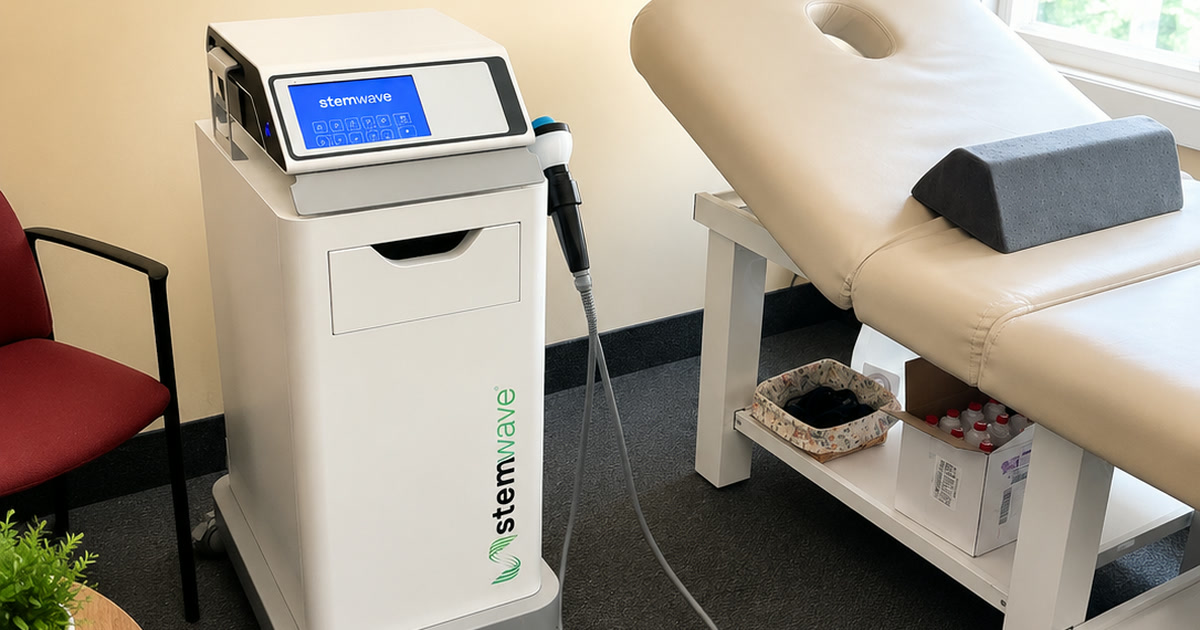
StemWave is the shockwave system we use in Bowie. It delivers focused acoustic waves into soft tissue and is designed to stimulate the body's natural healing response. A visit is typically brief, and most people go back to ordinary daily activity afterward. Comfort varies; our StemWave comfort guide explains what a session may feel like.
I offer it when the problem has been lingering, the exam fits a soft-tissue pattern, and we have talked about training load, shoes, and what you have already tried. It is not a way to push through a stress fracture, a sudden tendon pop, or an injury that needs urgent medical care. If shockwave is not the right fit, we look at a different plan or a referral.
New patients can begin with a $50 first session. You can learn more about StemWave or schedule a visit. If you want the office overview, including what happens at a first visit, see our StemWave first-session guide.
Who in Bowie and Prince George's County is this for?
I see runners and walkers from Bowie and Prince George's County, including Crofton, Mitchellville, Glenn Dale, Upper Marlboro, Lanham, and Largo, and people who train along paths and roads near US-50, MD-197, US-301, MD-450, and Route 214. If a training cycle has stalled because of shin, IT band, or heel pain, I would rather look at it carefully than have you guess from a forum post.
Frequently Asked Questions
Can I run the same day as a StemWave session?
Many people return to ordinary daily activity after a visit. Whether you should run that day depends on the area we worked on and how it feels. I would rather you ask in the room than test it on a hard workout.
Is shockwave therapy a replacement for rest and physical therapy?
No. MedlinePlus still points to activity changes, stretching, and time as the foundation for shin splints, IT band irritation, and plantar fasciitis. Shockwave therapy is a possible next discussion when those measures have not been enough, not a way to skip them.
How soon could I notice a change?
It varies. Some people feel a difference sooner; more meaningful change, when it happens, is often gradual over a series of visits. Individual results vary.
What should I do if I think I have a stress fracture?
Do not try to run through it. Pain that is becoming more focal, is present at rest, or is not easing with time away from running needs a medical evaluation. I will not suggest StemWave until we know we are not dealing with a stress fracture or another problem that needs a different plan.
Who should not have shockwave therapy?
We screen for issues such as pregnancy, a tumor or infection in the area, and certain implanted devices, and we review your health history first. Our contraindications guide covers this in more detail.
How much is a first session?
New patients can begin with a $50 first session. That visit is a chance to examine the area, talk about your training, and see whether StemWave is a reasonable option for you.
Visit Total Wellness Chiropractic in Bowie
Total Wellness Chiropractic 6000 Laurel Bowie Road, Suite 202 Bowie, MD 20715 (301) 352-3454
Individual results may vary. This post is for general information and is not a promise of a particular outcome. StemWave is not a substitute for emergency care. Seek urgent or emergency evaluation for a sudden tendon pop, inability to bear weight, rapidly worsening swelling, or signs of a serious injury.
Sources
- MedlinePlus. Shin splints - self-care. https://medlineplus.gov/ency/patientinstructions/000654.htm
- MedlinePlus. Iliotibial band syndrome - aftercare. https://medlineplus.gov/ency/patientinstructions/000683.htm
- MedlinePlus. Plantar fasciitis. https://medlineplus.gov/ency/article/007021.htm